




Keyword
Keyword

SuperseaL Solid Shaft Ferrofluid Rotary Motion Feedthrough for bulkheads 3/4 to 1 in. thick, with transmission torque of 160 lbs-in. Includes O-Ring, nut and washer.FD-LSR-0375-LC, 605353These vacuum rotary feedthroughs are designed for 3/4 to 1 inch thick bulkhead port connections. They are a ferromagnetic sealed device which uses dynamic sealing to allow wear-free and leak-free rotation of a solid shaft. These high performance vacuum rotary motion feedthroughs have the following features: 3/8 inch Diameter Shaft Maximum No-Load Rotary Speeds Up To 5000 RPM Maximum Bearing Dynamic Load Capacity 575 lbs Maximum Bearing Static Load Capacity 305 lbs Transmission Torque 160 lbs-in Break-away Drag torque 11 oz-in Drag torque @100 RPM 6 oz-in Drag torque @1000 RPM 9 oz-in A300S Ferrofluid Base Hydrocarbon Oil Maximum 80°C Operating Temperature Please see Specifications Sheet and Feedthrough Catalog pg. 10 & 11 for more information The vacuum tight dynamic seal is formed by the ferromagnetic particles suspended in the magnetic fluid (A300S) which interacts directly with the magnetic field generated by the feedthrough’s internal magnets. In these rotary feedthroughs, narrow rings of fluid (shown in figure below) forms a liquid barrier filling the annular spaces (or gaps) between a rotating shaft and the tips of the stationary pole magnetic piece. Since magnetic fluids can be pushed, pulled, and shaped by magnetic field they remain stationary to form a vacuum tight seal. Radially, the fluid rings are bounded by the magnetic pole piece tips. Magnetic flux density at the pole tips is very large. Hence, any axial displacement of a liquid ring away from the pole tip results in a force that resists the displacement. The isolated volumes between adjacent rings are important in the functioning of the device. Several different arrangements of housing, bearings, magnets and fluids are used for the many types of rotary vacuum feedthroughs. Many factors must be considered when selecting a rotary feedthrough for your process. The "Feedthrough Catalog" in PDF format is provided for download here that explains the technical functions and applications of magnetic fluid rotary feedthroughs. Topics include: Basic principles of magnetic ferro sealing Feedthrough Application examples Benefits of a magnetic ferro seal and the SuperseaL design Feedthrough designs and specifications
Condition: New
Part Number: P107214
Price: €857.06
SuperseaL Solid Shaft Ferrofluid Ferromagnetic Rotary Motion Feedthrough for Bulkheads 3/4 in. to 1 in. Thick with 50 lbs-in. transmission torque. Includes O-Ring, nut and washer. FD-LSR-0250-LC, 605357These vacuum rotary feedthroughs are designed for 3/4 to 1 inch bulkhead port connections. They are a ferromagnetic sealed device which uses dynamic sealing to allow free rotation of a solid shaft. These high performance vacuum rotary motion feedthroughs have the following features: 3/8 inch Diameter Shaft Maximum No-Load Rotary Speeds Up To 5000 RPM Maximum Bearing Dynamic Load Capacity 575 lbs Maximum Bearing Static Load Capacity 305 lbs Transmission Torque 50 lbs-in Break-away Drag torque 11 oz-in Drag torque @100 RPM 6 oz-in Drag torque @1000 RPM 9 oz-in A300S Ferrofluid Base Hydrocarbon Oil Maximum 80°C Operating Temperature Please see Specifications Sheet and Feedthrough Catalog pg. 10 & 11 for more information The vacuum tight dynamic seal is formed by the ferromagnetic particles suspended in the magnetic fluid (A300S) which interacts directly with the magnetic field generated by the feedthrough’s internal magnets. In these rotary feedthroughs, narrow rings of fluid (shown in figure below) form a liquid barrier filling the annular spaces (or gaps) between a rotating shaft and the tips of the stationary pole magnetic piece. Since magnetic fluids can be pushed, pulled, and shaped by magnetic fields they remain stationary to form a vacuum tight seal. Radially, the fluid rings are bounded by the magnetic pole piece tips. Magnetic flux density at the pole tips is very large. Hence, any axial displacement of a liquid ring away from the pole tip results in a force that resists the displacement. The isolated volumes between adjacent rings are important in the functioning of the device. Several different arrangements of housing, bearings, magnets and fluids are used for the many types of rotary vacuum feedthroughs. Many factors must be considered when selecting a rotary feedthrough for your process. The "Feedthrough Catalog" in PDF format is provided here for download that explains the technical functions and applications of magnetic fluid rotary feedthroughs. Topics include: Basic principles of magnetic ferro sealing Feedthrough Application examples Benefits of a magnetic ferro seal and the SuperseaL design Feedthrough designs and specifications
Condition: New
Part Number: P107215
Price: €857.06

SuperseaL Solid Shaft Ferrofluid Ferromagnetic Rotary Motion Feedthrough KF25 flange, FD-F1-KF25-0250-LC, 605794These KF-25 flanged vacuum rotary feedthroughs, are a ferromagnetic sealed device, which uses dynamic sealing to allow free rotation of a solid shaft. These high performance vacuum rotary motion feedthroughs have the following features: 1/4 inch Diameter Shaft Maximum No-Load Rotary Speeds Up To 5000 RPM Maximum Bearing Dynamic Load Capacity 569 lbs Maximum Bearing Static Load Capacity 273 lbs Transmission Torque 160 lbs-in Break-away Drag torque 11 oz-in Drag torque @100 RPM 6 oz-in Drag torque @1000 RPM 9 oz-in A300S Ferrofluid Base Hydrocarbon Oil Maximum 80°C Operating Temperature Please see Specifications Sheet for more information The vacuum tight dynamic seal is formed by the ferromagnetic particles suspended in the magnetic fluid (A300S) which interacts directly with the magnetic field generated by the feedthrough’s internal magnets. In these rotary feedthroughs, narrow rings of fluid (shown in figure below) forms a liquid barrier filling the annular spaces (or gaps) between a rotating shaft and the tips of the stationary pole magnetic piece. Since magnetic fluids can be pushed, pulled, and shaped by magnetic fields, they remain stationary to form a vacuum tight seal. Radially, the fluid rings are bounded by the magnetic pole piece tips. Magnetic flux density at the pole tips is very large. Hence, any axial displacement of a liquid ring away from the pole tip results in a force that resists the displacement. The isolated volumes between adjacent rings are important in the functioning of the device. Several different arrangements of housing, bearings, magnets and fluids are used for the many types of rotary vacuum feedthroughs. Many factors must be considered when selecting a rotary feedthrough for your process. The "Feedthrough Catalog" in PDF format is provided for download below that explains the technical functions and applications of magnetic fluid rotary feedthroughs. Topics include: Basic principles of magnetic ferro sealing Feedthrough Application examples Benefits of a magnetic ferro seal and the SuperseaL design Feedthrough designs and specifications
Condition: New
Part Number: P107199
Price: €857.06
SuperseaL Solid Shaft Ferrofluid Ferromagnetic Rotary Motion Feedthrough KF25 to KF25 clamp flange, FD-F1-KF25-250-LC, 605794These KF-25 flanged vacuum rotary feedthroughs, are a ferromagnetic sealed device, which uses dynamic sealing to allow free rotation of a solid shaft. These high performance vacuum rotary motion feedthroughs have the following features: 3/8 (0.375) inch Diameter Shaft Maximum No-load Rotary Speeds Up To 5000 RPM Maximum Bearing Static Load 273 lb Maximum Bearing Dynamic Load 569 lb Transmission Torque 160 lb-in Break-Away Drag Torque: 11 oz-in Drag Torque @ 100 RPM 6 oz-in Drag Torque @ 1,000 RPM oz-in A300S Ferrofluid Base Hydrocarbon Oil Maximum Operating Temperature 80°C Please see Specifications Sheet for more information. The vacuum tight dynamic seal is formed by the ferromagnetic particles suspended in the magnetic fluid (A300S) which interacts directly with the magnetic field generated by the feedthrough’s internal magnets. In these rotary feedthroughs, narrow rings of fluid (shown in figure below) forms a liquid barrier filling the annular spaces (or gaps) between a rotating shaft and the tips of the stationary pole magnetic piece. Since magnetic fluids can be pushed, pulled, and shaped by magnetic fields, they remain stationary to form a vacuum tight seal. Radially, the fluid rings are bounded by the magnetic pole piece tips. Magnetic flux density at the pole tips is very large. Hence, any axial displacement of a liquid ring away from the pole tip results in a force that resists the displacement. The isolated volumes between adjacent rings are important in the functioning of the device. Several different arrangements of housing, bearings, magnets and fluids are used for the many types of rotary vacuum feedthroughs. Many factors must be considered when selecting a rotary feedthrough for your process. The "Feedthrough Catalog" in PDF format is provided for download below that explains the technical functions and applications of magnetic fluid rotary feedthroughs, which includes: Basic principles of magnetic ferro sealing Feedthrough Application examples Benefits of a magnetic ferro seal and the SuperseaL design Feedthrough designs and specifications
Condition: New
Part Number: P1010432
Price: €860.98

SuperseaL Solid Shaft Ferrofluid Rotary Motion Feedthrough, 389 lb Transmission Torque for KF40 flange, FD-KF40-0500-LC, 1003308These KF-40 flanged vacuum rotary feedthroughs, are a ferromagnetic sealed device, which uses dynamic sealing to allow wear-free and leak-free rotation of a solid shaft. These feedthroughs are not grounded or electrically isolated. These high performance vacuum rotary motion feedthroughs have the following features: 1/2 (0.50) inch Diameter Shaft Maximum No-load Rotary Speeds Up To 3900 RPM Maximum Bearing Static Load 344 lb Maximum Bearing Dynamic Load 684 lb Transmission Torque 389 lb-in Break-Away Drag Torque: 14 oz-in Drag Torque @ 100 RPM 8 oz-in Drag Torque @ 1,000 RPM 12 oz-in A300S Ferrofluid Base Hydrocarbon Oil Maximum Operating Temperature 80°C Please see Specifications Sheet for more information The vacuum tight dynamic seal is formed by the ferromagnetic particles suspended in the magnetic fluid (A300S) which interacts directly with the magnetic field generated by the feedthrough’s internal magnets. In these rotary feedthroughs, narrow rings of fluid (shown in figure below) forms a liquid barrier filling the annular spaces (or gaps) between a rotating shaft and the tips of the stationary pole magnetic piece. Since magnetic fluids can be pushed, pulled, and shaped by magnetic fields, they remain stationary to form a vacuum tight seal. Radially, the fluid rings are bounded by the magnetic pole piece tips. Magnetic flux density at the pole tips is very large. Hence, any axial displacement of a liquid ring away from the pole tip results in a force that resists the displacement. The isolated volumes between adjacent rings are important in the functioning of the device. Several different arrangements of housing, bearings, magnets and fluids are used for the many types of rotary vacuum feedthroughs. Many factors must be considered when selecting a rotary feedthrough for your process. The "Feedthrough Catalog" in PDF format is provided for download below that explains the technical functions and applications of magnetic fluid rotary feedthroughs, which includes: Basic principles of magnetic ferro sealing Feedthrough Application examples Benefits of a magnetic ferro seal and the SuperseaL design Feedthrough designs and specifications
Condition: New
Part Number: P108288
Price: €1,074.04
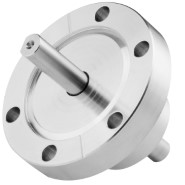
SuperseaL Solid Shaft Ferrofluid Ferromagnetic Rotary Motion Feedthrough for CF 2.75 inch, FD-CF-0375-LC, 605774These CF 2.75 inch vacuum rotary feedthroughs, are a ferromagnetic sealed device, which uses dynamic sealing to allow wear-free and leak-free rotation of a solid shaft. These high performance vacuum rotary motion feedthroughs have the following features: 3/8 inch Diameter Shaft Maximum No-Load Rotary Speeds Up To 5000 RPM Maximum Bearing Dynamic Load Capacity 569 lbs Maximum Bearing Static Load Capacity 273 lbs Transmission Torque 160 lbs-in Break-away Drag torque 11 oz-in Drag torque @100 RPM 6 oz-in Drag torque @1000 RPM 9 oz-in A300S Ferrofluid Base Hydrocarbon Oil Maximum 80°C Operating Temperature Please see Specifications Sheet for more information The vacuum tight dynamic seal is formed by the ferromagnetic particles suspended in the magnetic fluid (A300S) which interacts directly with the magnetic field generated by the feedthrough’s internal magnets. In these rotary feedthroughs, narrow rings of fluid (shown in figure below) form a liquid barrier filling the annular spaces (or gaps) between a rotating shaft and the tips of the stationary pole magnetic piece. Since magnetic fluids can be pushed, pulled, and shaped by magnetic fields they remain stationary to form a vacuum tight seal. Radially, the fluid rings are bounded by the magnetic pole piece tips. Magnetic flux density at the pole tips is very large. Hence, any axial displacement of a liquid ring away from the pole tip results in a force that resists the displacement. The isolated volumes between adjacent rings are important in the functioning of the device. Several different arrangements of housing, bearings, magnets, and fluids are used for the many types of rotary vacuum feedthroughs. Many factors must be considered when selecting a rotary feedthrough for your process. The "Feedthrough Catalog" in PDF format is provided for download below that explains the technical functions and applications of magnetic fluid rotary feedthroughs, which includes: Basic principles of magnetic ferro sealing Feedthrough Application examples Benefits of a magnetic ferro seal and the SuperseaL design Feedthrough designs and specifications
Condition: New
Part Number: P107213
Price: €1,074.04