The
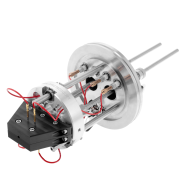
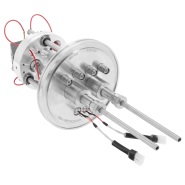
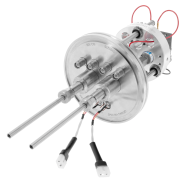
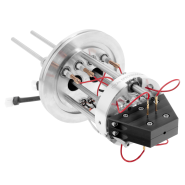
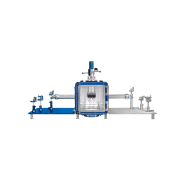
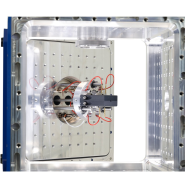
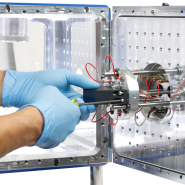
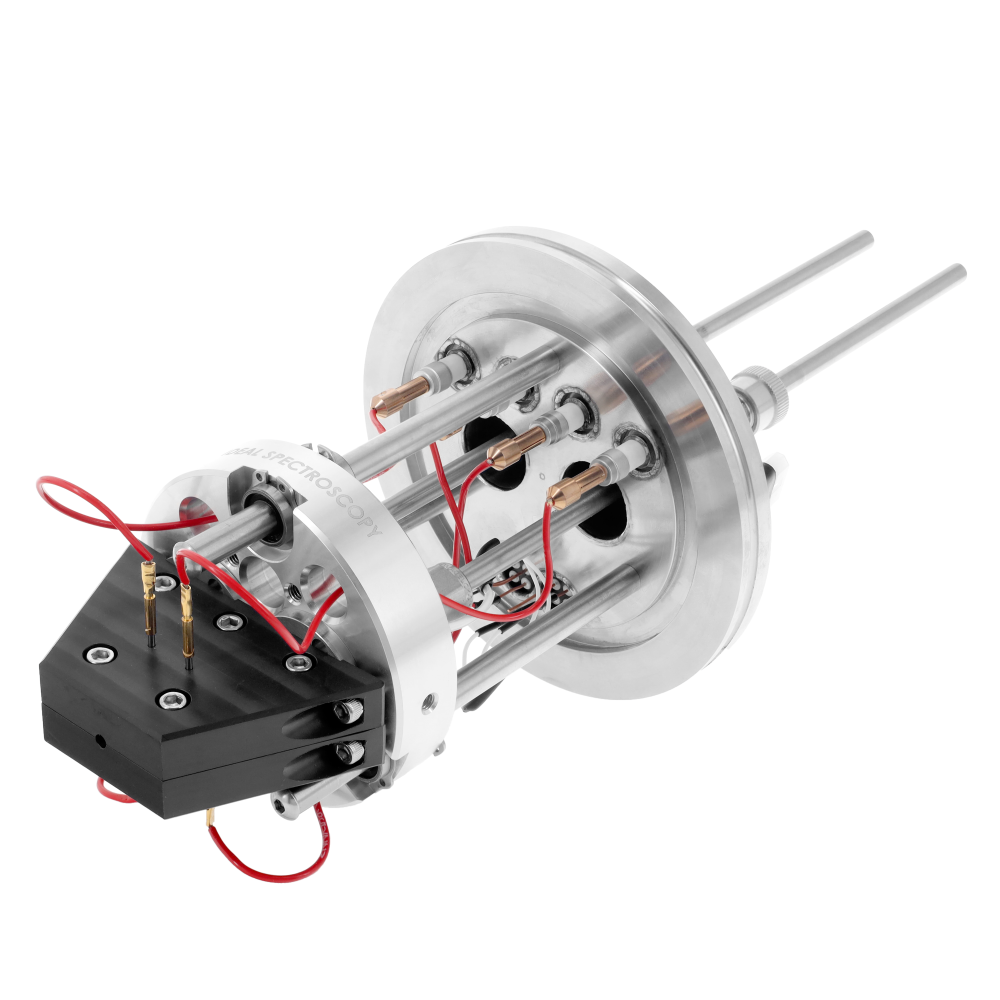
Ideal Spectroscopy TwinJet™ Dual Pulsed Discharge Jet Nozzle is an advanced two-precursor molecular beam source designed to produce highly reactive molecules that are difficult or impossible to generate using a conventional single-stream discharge nozzle. The TwinJet integrates two independent high-speed pulsed valves, two separate gas-delivery channels, and two independently energized discharge sections that converge at a common mixing region near the throat of the supersonic expansion nozzle.
Each TwinJet channel can carry a different chemical precursor diluted to a low concentration in a high-pressure inert buffer gas such as argon or helium. The two precursor mixtures remain physically separated within their respective valves and discharge passages, preventing premature reactions while allowing unstable, incompatible, corrosive, or highly reactive gas combinations to be handled as independent streams.
Each channel can be operated with its discharge energized or turned off. Valve timing, discharge timing, precursor concentration, buffer gas selection, backing pressure, and discharge conditions can all be adjusted independently for each side. Researchers can discharge both precursor streams, discharge only one stream, or introduce either stream without discharge depending on the reaction pathway being investigated.
After passing through their respective discharge regions, the two gas streams enter a short mixing region at the nozzle throat. Reactive fragments formed in the separate channels are combined only immediately before the mixture undergoes free-jet expansion into the vacuum chamber. This short reaction time promotes formation of the desired transient molecule while minimizing precursor decomposition, wall reactions, and unwanted secondary chemistry.
The resulting supersonic expansion rapidly cools the reaction products to form a pulsed molecular beam containing rotationally cold radicals and reactive intermediates. The TwinJet is ideally suited for
Laser-Induced Fluorescence (LIF),
Dispersed Fluorescence (DF), emission spectroscopy, and other gas-phase molecular spectroscopy techniques requiring controlled production of short-lived molecular species.
A representative application uses a dilute mixture of disilane (Si
2H
6) in argon in one channel and a dilute mixture of oxygen (O
2) in argon in the second channel. The precursor streams are separately discharged, and the resulting products are mixed immediately before expansion. This approach enabled the first gas-phase spectroscopic identification of hydroxysilylene (HSiOH).
This work was reported by Tyler J. Herman, Fumie X. Sunahori, Tony C. Smith, and Dennis J. Clouthier in
Hydroxysilylene (HSi-OH) in the Gas Phase, Journal of Chemical Physics, Volume 162, Article 044301 (2025), DOI: 10.1063/5.0249684. The study demonstrated that the strongest and most stable LIF signals were obtained by discharging both independent precursor streams and merging the discharge products immediately before expansion into vacuum.
The same TwinJet approach has also been successfully used to generate previously unobserved transient molecules from separate precursor streams, including HSnCl and HSnBr, demonstrating the value of isolating precursors until the final mixing and expansion stage.
Two
Ideal Spectroscopy PDD-100 Pulsed Discharge Drivers are used to independently control the TwinJet discharge sections. TTL-compatible triggering allows both discharges to be synchronized with the pulsed valves, excitation laser, detector, and laboratory timing or data-acquisition system.
Features:
- Two independent high-speed pulsed valves
- Two isolated precursor and buffer-gas channels
- Two independently energized discharge sections
- Keeps incompatible or reactive precursors separated until use
- Allows either, both, or neither precursor stream to be discharged
- Independent optimization of valve timing, discharge timing, and operating conditions
- Rapid mixing at the supersonic nozzle throat
- Minimizes premature reactions and precursor decomposition
- Produces radicals, transient molecules, and reactive intermediates
- Rapid supersonic cooling for rotationally cold molecular beams
- Operates with two Ideal Spectroscopy PDD-100 Pulsed Discharge Drivers
- Suitable for LIF, DF, emission spectroscopy, and related gas-phase spectroscopy techniques
- Demonstrated by the first gas-phase spectroscopic identification of hydroxysilylene (HSiOH)
Custom Materials Science and Surface Processing Applications:
Beyond molecular spectroscopy, the
SpectraJet™ and
TwinJet™ platforms can be adapted for experimental materials science applications requiring timed delivery, activation, mixing, or directed expansion of gaseous precursors and reactive species into a vacuum chamber. Potential research applications include pulsed and reactive molecular beam experiments, gas-surface reaction studies, precursor screening, radical-assisted surface processing, thin-film and coating development, nanoparticle or cluster formation, and specialized gas-source, hybrid, or plasma-assisted epitaxy research.
The independently controlled
TwinJet™ configuration is especially valuable when two precursors must remain isolated until activation or mixing near the nozzle exit. Because deposition systems vary widely in operating pressure, gas load, substrate geometry, operating temperature, material compatibility, beam distance, and process-control requirements, these products should be evaluated and configured for each specific application.
Ideal Vacuum welcomes custom source, nozzle, electrode, valve, mounting, feedthrough, heating, cooling, and control-system design requests for new vacuum processing and advanced materials research applications.
The TwinJet provides molecular spectroscopy laboratories with a flexible platform for exploring reaction pathways that cannot be achieved by premixing precursors in a single gas cylinder or pulsed valve. It is designed to help researchers rapidly evaluate new precursor combinations, optimize reactive-species production, and identify new molecules under cold, isolated gas-phase conditions.