



Keyword
Keyword

Agilent Cary 60 UV-Vis Spectrophotometer, Wavelength range of 190–1100 nm. Optional 21 CFR Part 11 software tools are available for purchase. Agilent Part Number: G6860A. The Cary 60 UV-Vis spectrophotometer has a wavelength range of 190–1100 nm that can be scanned in under three seconds. Our versatile UV-Vis spectrophotometer can be fitted with long pathlength cuvettes and solid sample transmission or reflectance accessories, and is ideal for remote UV-Vis absorbance analysis, when fitted with fiber optic probes. The xenon source lamp has a 10 year replacement warranty (for Cary 60 instruments purchased from Agilent or participating partners), requires zero warmup, and causes no photodegradation of samples. Fast reactions can be recorded with 80 data points per second. The Cary 60 is well-suited as a routine UV-Vis spectrophotometer or for use in teaching labs. Optional 21 CFR Part 11 software tools are available (S101132). FEATURES Reduce time-consuming and expensive lamp replacements, and minimize instrument revalidation costs with the unique Agilent xenon source lamp. Safely measure life-science samples without sample photodegradation and be sure that you get the correct answer every time with the Cary 60 UV-Vis spectrophotometer. Get reliable UV-Vis spectrophotometer performance with fiberoptic measurement probes. Why use cuvettes when you can bring the UV-Vis instrument to the sample and get accurate results in a fraction of the time? Measure small volumes and precious samples accurately and reproducibly with a highly focused beam image. Scan the entire wavelength range (190 to 1100 nm) in under three seconds and collect data from single or multiple wavelengths at 80 data points per second. Take advantage of the Cary 60 UV-Vis spectrophotometer’s comprehensive range of accessories to accurately characterize the widest variety of liquid and solid samples. Tailor the Cary WinUV software to suit your analytical requirements. From classroom to research laboratories through R&D and regulated QA/QC environments, simplify your UV-Vis spectroscopy measurements and get more done in less time. Choose sustainability: The Cary 60 UV-Vis received My Green Lab’s ACT (Accountability, Consistency, Transparency) label after independent audit for its environmental impact throughout the product lifecycle.
Condition: New
Part Number: S101131
Price: $12,581.14
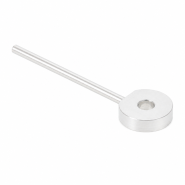
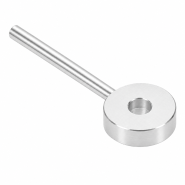
Replacement Electrodes for Ideal Spectroscopy SpectraJet™ Pulsed Discharge Jet Nozzle These replacement electrodes are designed for use with the Ideal Spectroscopy SpectraJet™ Pulsed Discharge Jet Nozzle. They replace worn or damaged electrodes to help maintain reliable discharge performance during experiments. The electrodes are designed for straightforward replacement and proper integration with the SpectraJet™ nozzle assembly. Key Features: Replacement electrodes for the SpectraJet™ Pulsed Discharge Jet Nozzle Designed for reliable pulsed discharge operation Direct replacement for worn or damaged electrodes Easy integration with the SpectraJet™ nozzle assembly
Condition: New
Part Number: S101253
Price: $69.00
Replacement Electrodes for Ideal Spectroscopy TwinJet™ Dual Pulsed Discharge Jet Nozzle These replacement electrodes are designed for use with the Ideal Spectroscopy TwinJet™ Dual Pulsed Discharge Jet Nozzle. They replace worn or damaged electrodes to help maintain reliable discharge performance during experiments. The electrodes are designed for straightforward replacement and proper integration with the TwinJet™ nozzle assembly. Key Features: Replacement electrodes for the TwinJet™ Dual Pulsed Discharge Jet Nozzle Designed for reliable pulsed discharge operation Direct replacement for worn or damaged electrodes Easy integration with the TwinJet™ nozzle assembly
Condition: New
Part Number: S101254
Price: $55.50
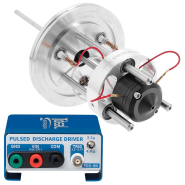
Ideal Spectroscopy SpectraJet Pulsed Discharge Jet Nozzle and PDD-100 Pulsed Discharge Driver Kit for LIF and Molecular Beam Spectroscopy This Ideal Spectroscopy SpectraJet Pulsed Discharge Jet Kit combines the SpectraJet Single Pulsed Discharge Jet Nozzle with the PDD-100 Pulsed Discharge Driver to provide an integrated solution for generating radicals, transient molecules, and reactive intermediates in rotationally cold supersonic molecular beams. The SpectraJet integrates a high-speed pulsed valve, electrical discharge section, and supersonic expansion nozzle into a compact assembly designed for installation inside a vacuum chamber. During operation, a selected chemical precursor can be entrained in a high-pressure inert buffer gas such as argon or helium. The pulsed valve delivers a controlled gas pulse through the discharge region, where the PDD-100 provides a precisely timed electrical discharge to fragment or dissociate the precursor immediately before expansion into the vacuum chamber. The resulting supersonic expansion rapidly cools the generated molecular species while minimizing downstream collisions and secondary reactions. This produces a pulsed molecular beam suitable for Laser-Induced Fluorescence (LIF), Dispersed Fluorescence (DF), emission spectroscopy, high-resolution molecular spectroscopy, and other gas-phase molecular beam experiments. The included PDD-100 Pulsed Discharge Driver operates from an 18 to 36 VDC power source and accepts a TTL-compatible trigger input, allowing the electrical discharge to be precisely synchronized with the SpectraJet pulsed valve, laser, detector, and laboratory timing system. The driver provides an SHV high-voltage output for connection to the discharge electrode assembly through an appropriate vacuum feedthrough. By combining the SpectraJet nozzle and PDD-100 driver into one kit, researchers have the primary discharge-generation components required for a coordinated pulsed discharge jet source without having to separately select and match the discharge nozzle and driver. Kit Includes: One Ideal Spectroscopy SpectraJet Single Pulsed Discharge Jet Nozzle One Ideal Spectroscopy PDD-100 Pulsed Discharge Driver Features Include: Integrated solution for pulsed discharge jet experiments Generates radicals, transient molecules, and reactive intermediates Produces rotationally cold species through rapid supersonic expansion Single pulsed-valve and precursor-gas channel Integrated pulsed electrical discharge section Designed for argon, helium, and other suitable buffer gases 18 to 36 VDC PDD-100 input power TTL-compatible triggering for precise synchronization SHV high-voltage output from the PDD-100 Reproducible discharge timing for pulsed molecular beam experiments Typical Applications: Laser-Induced Fluorescence (LIF) spectroscopy Dispersed Fluorescence (DF) spectroscopy Emission spectroscopy Free radical and reactive intermediate generation Supersonic molecular beam experiments Gas-phase reaction studies High-resolution molecular spectroscopy Physical chemistry research
Condition: New
Part Number: S101293
Price: $6,517.55
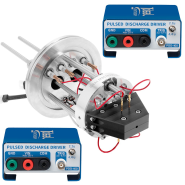
Ideal Spectroscopy TwinJet Dual Pulsed Discharge Jet Nozzle and Two PDD-100 Pulsed Discharge Driver Kit for LIF and Molecular Beam Spectroscopy This Ideal Spectroscopy TwinJet Dual Pulsed Discharge Jet Kit combines the TwinJet Dual Pulsed Discharge Jet Nozzle with two PDD-100 Pulsed Discharge Drivers to provide an integrated solution for generating radicals, transient molecules, and reactive intermediates from two independently controlled precursor streams. The TwinJet is an advanced two-precursor molecular beam source designed for experiments requiring reactive molecular species that may be difficult or impossible to generate using a conventional single-stream discharge nozzle. The system incorporates two independent high-speed pulsed valves, two separate precursor and buffer-gas channels, and two independently energized discharge sections that converge at a common mixing region near the throat of the supersonic expansion nozzle. Each TwinJet channel can carry a different chemical precursor diluted in a high-pressure inert buffer gas such as argon or helium. The two precursor mixtures remain physically separated within their respective valves and discharge passages, helping prevent premature reactions while allowing unstable, incompatible, or highly reactive precursor combinations to be introduced as independent streams. Two included PDD-100 Pulsed Discharge Drivers independently control the TwinJet discharge sections. Each driver accepts a TTL-compatible trigger input, allowing the two electrical discharges to be precisely synchronized with the pulsed valves, excitation laser, detector, and laboratory timing or data-acquisition system. Each PDD-100 operates from an 18 to 36 VDC power source and provides an SHV high-voltage output for connection to the corresponding discharge electrode assembly. The independent configuration allows researchers to discharge both precursor streams, discharge only one stream, or introduce either stream without discharge depending on the reaction pathway being investigated. Valve timing, discharge timing, precursor concentration, buffer gas selection, backing pressure, and discharge conditions can be independently optimized for each side. After passing through their respective discharge regions, the two gas streams enter a short mixing region near the nozzle throat. Reactive fragments generated in the separate channels are combined immediately before expansion into the vacuum chamber. This arrangement helps minimize premature reactions, precursor decomposition, wall reactions, and unwanted secondary chemistry. The resulting supersonic expansion rapidly cools the reaction products, producing a pulsed molecular beam containing rotationally cold radicals and reactive intermediates. The TwinJet system is well suited for Laser-Induced Fluorescence (LIF), Dispersed Fluorescence (DF), emission spectroscopy, high-resolution molecular spectroscopy, and other gas-phase experiments requiring controlled generation of short-lived molecular species. Kit Includes: One Ideal Spectroscopy TwinJet Dual Pulsed Discharge Jet Nozzle Two Ideal Spectroscopy PDD-100 Pulsed Discharge Drivers Features Include: Complete TwinJet nozzle and dual discharge-driver combination Two independent high-speed pulsed valves Two isolated precursor and buffer-gas channels Two independently energized discharge sections Two PDD-100 Pulsed Discharge Drivers for independent discharge control Keeps separate precursor streams isolated until mixing near the nozzle throat Allows either, both, or neither precursor stream to be discharged Independent optimization of valve and discharge timing Rapid mixing immediately before supersonic expansion Generates radicals, transient molecules, and reactive intermediates Rapid supersonic cooling for rotationally cold molecular beams 18 to 36 VDC input power for each PDD-100 driver TTL-compatible triggering for precise synchronization SHV high-voltage outputs for connection to the discharge electrode assemblies Typical Applications: Laser-Induced Fluorescence (LIF) spectroscopy Dispersed Fluorescence (DF) spectroscopy Emission spectroscopy Free radical and reactive intermediate generation Two-precursor reaction studies Supersonic molecular beam experiments Gas-phase reaction studies High-resolution molecular spectroscopy Physical chemistry research
Condition: New
Part Number: S101294
Price: $10,103.93

Ideal Spectroscopy Photodiode Variable Bias Module, 0-24 VDC 24V, 2A DC Converter Power Supply Included This is an 0-24 VDC Ideal Spectroscopy photodiode variable bias module with included 24V, 2A DC power supply. This module is used to apply a DC bias to a compatible photodiode for greater sensitivity and linearity, and more rapid time response. The bias voltage is adjusted via a rotatable knob on the side of the bias module. The photodiode must be attached via the input female BNC connector. The output is monitored by connection to the output female BNC connector. Optionally, the 0-24 VDC bias voltage may be monitored via connection to the bias monitor female BNC connector for precise voltage control. Photodiodes are light detectors used in many spectroscopy applications. An unbiased photodiode acts as a photovoltaic device, which generates a single electron of current per excitation event. The photodiode output may be monitored either by measuring the current produced or by applying a resistance to the photodiode output and measuring the voltage build up as current is impeded. Photovoltaic operation is the simplest mode of action and has minimal dark current. Unfortunately it suffers from low amplification, nonlinear voltage response over large dynamic ranges, and slow response due to a short depetion width and large junction capacitance. Unbiased photodiodes are best for slow or very low light applications. Photodiodes may be reverse biased to change their response from photovoltaic to photoconductive. Under reverse biasing the depletion width increases, the junction capacitance decreases, and the response speeds up. The current response is amplified and becomes more linear over a larger dynamic range than in photovoltaic mode. The cost of these enhancements is increased dark noise and the propagation of electrical artifacts from the biasing power supply to the photodiode output signal. Using a clean power supply, such as Ideal Spectroscopy’s photodiode bias module, is critical for good response. Biasing photodiodes is best for applications where rapid time response or high linearity over a large range of light intensities is needed. Photodiode Variable Bias Module Specifications: Compatible Photodiodes: Anode-grounded, photoconductive Input Voltage: 24 VDC nominal, regulated, <100 mV ripple preferred Input Connection Type: Barrel Receptical, 5.5 mm OD, 2.1 mm ID Photodiode Bias Voltage: 0.8 - 23.4 VDC, variable Photodiode Bias Maximum Current: 3 A, <100 mA typical Photodiode Bias Load Regulation: ±2% typical Photodiode Bias Line Regulation: ±1% typical Photodiode Bias Ripple: <50 mV peak-peak at typical load Photodiode Bias Connection: BNC female, center positive Bias Monitor Voltage: 0.8 - 23.4 VDC, variable Bias Monitor Connection: BNC female Output Voltage: 0 - 5 V typical Output Connection: BNCfFemale Operating Temperatures: -40 to 85 °C Operating Humidity: <85% RH non-condensing 24V DC Power Supply Specifications: Input Voltage: 90 - 240 VAC Input Frequency: 47-63 Hz Output Voltage: 24.0±1.2 VDC Output Voltage Ripple: ±1% Rated Output Current: 2.5 A Input Connector: NEMA 1-15P Output Connector: Barrel, 5.5 mm OD, 2.1 mm ID Output Connector Polarity: Center positive Safety Approvals: UL60950-1, cUL60950-1 EMC Approvals: FCC
Condition: New
Part Number: S101176
Price: $376.86
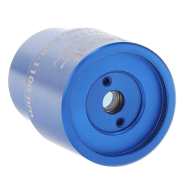
Ideal Spectroscopy Mounted Large-Area Silicon Photodiode, 350-1100 nm, Anode Grounded, BNC This Ideal Spectroscopy mounted large-area silicon photodiode is designed for detecting large visible and near-infrared beams or spots in the 350-1100 nm wavelength range. The photodiode is anode grounded and equipped with a female BNC electrical connection for easy integration with existing laboratory systems. This mounted photodiode is compatible with Ideal Spectroscopy’s Photodiode Variable Bias Module, which provides an adjustable bias of 0-24 VDC for a faster, more linear, amplified response. The anodized aluminum photodiode housing provides several mounting options for easy integration into optical systems. The front face is equipped with an internal SM1 thread for connection to a 1" diameter lens tube or other standard optical apparatus. The back of the housing has an external SM1 thread for installation into threaded optical mounts designed for 1" OD optics and devices. A smooth 1" OD section also allows the photodiode to be installed into kinematic mounts with a 1" ID smooth bore. An 8-32 threaded hole on the base of the housing allows for direct connection to standard optical posts. Specifications: Wavelength range: 350-1100 nm Active surface area: 13 mm2, square Peak responsivity wavelength: 970 nm Typical responsivity: 0.65 A/W Dark current: 0.35 nA typical, 6 nA maximum at 10 V reverse bias Rise time: 14 ns at 10 V reverse bias Maximum reverse bias: 30 VDC Electrical connection: Female BNC Configuration: Anode grounded Operating temperature range: -40 to 100 °C
Condition: New
Part Number: S101178
Price: $233.52
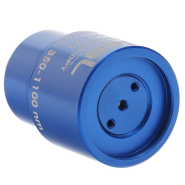
Ideal Spectroscopy Mounted Fast-Response Silicon Photodiode, 350-1100 nm, Anode Grounded, BNC This Ideal Spectroscopy mounted fast-response silicon photodiode is designed for detecting small, fast visible and near-infrared beams in the 350-1100 nm wavelength range. The photodiode is anode grounded and equipped with a female BNC electrical connection for easy integration with existing laboratory systems. This mounted photodiode is compatible with Ideal Spectroscopy’s Photodiode Variable Bias Module, which provides an adjustable bias of 0-24 VDC for a faster, more linear, amplified response. Care must be taken when setting the bias voltage, as the photodiode has a maximum reverse bias of 15 VDC. The anodized aluminum photodiode housing provides several mounting options for easy integration into optical systems. The front face is equipped with an internal SM1 thread for connection to a 1" diameter lens tube or other standard optical apparatus. The back of the housing has an external SM1 thread for installation into threaded optical mounts designed for 1" OD optics and devices. A smooth 1" OD section also allows the photodiode to be installed into kinematic mounts with a 1" ID smooth bore. An 8-32 threaded hole on the base of the housing allows for direct connection to standard optical posts. Specifications: Wavelength range: 350-1100 nm Active surface area: 0.20 mm2, round Peak responsivity wavelength: 800 nm Typical responsivity: 0.50 A/W Dark current: 0.06 nA typical, 1 nA maximum at 5 V reverse bias Rise time: 0.8 ns at 5 V reverse bias Maximum reverse bias: 15 VDC Electrical connection: Female BNC Configuration: Anode grounded Operating temperature range: -40 to 85 °C
Condition: New
Part Number: S101179
Price: $273.92
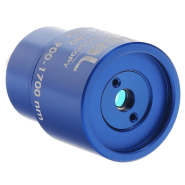
Ideal Spectroscopy Mounted Large-Area InGaAs Photodiode, 900-1700 nm, Anode Grounded, BNC This Ideal Spectroscopy mounted large-area InGaAs photodiode is designed for detecting large infrared beams or spots in the 900-1700 nm wavelength range. The photodiode is anode grounded and equipped with a female BNC electrical connection for easy integration with existing laboratory systems. The anodized aluminum photodiode housing provides several mounting options for easy integration into optical systems. The front face is equipped with an internal SM1 thread for connection to a 1" diameter lens tube or other standard optical apparatus. The back of the housing has an external SM1 thread for installation into threaded optical mounts designed for 1" OD optics and devices. A smooth 1" OD section also allows the photodiode to be installed into kinematic mounts with a 1" ID smooth bore. An 8-32 threaded hole on the base of the housing allows for direct connection to standard optical posts. Specifications: Wavelength range: 900-1700 nm Active surface area: 3.0 mm2, round Typical responsivity: 0.9 A/W Shunt resistance: 20 MO Maximum reverse bias: 2 VDC Electrical connection: Female BNC Configuration: Anode grounded Operating temperature range: -40 to 75 °C
Condition: New
Part Number: S101180
Price: $796.00
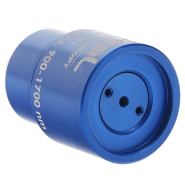
Ideal Spectroscopy Mounted Fast-Response InGaAs Photodiode, 900-1700 nm, Anode Grounded, BNC This Ideal Spectroscopy mounted fast-response InGaAs photodiode is designed for detecting small, fast infrared beams in the 900-1700 nm wavelength range. The photodiode is anode grounded and equipped with a female BNC electrical connection for easy integration with existing laboratory systems. This mounted photodiode is compatible with Ideal Spectroscopy’s Photodiode Variable Bias Module, which provides an adjustable bias of 0-24 VDC for a faster, more linear, amplified response. Care must be taken when setting the bias voltage, as the photodiode has a maximum reverse bias of 20 VDC. The anodized aluminum photodiode housing provides several mounting options for easy integration into optical systems. The front face is equipped with an internal SM1 thread for connection to a 1" diameter lens tube or other standard optical apparatus. The back of the housing has an external SM1 thread for installation into threaded optical mounts designed for 1" OD optics and devices. A smooth 1" OD section also allows the photodiode to be installed into kinematic mounts with a 1" ID smooth bore. An 8-32 threaded hole on the base of the housing allows for direct connection to standard optical posts. Specifications: Wavelength range: 900-1700 nm Active surface area: 0.045 mm2, round Typical responsivity: 0.90 A/W Dark current: 0.05 nA typical, 2 nA maximum at 5 V reverse bias Rise time: 0.3 ns at 5 V reverse bias Maximum reverse bias: 20 VDC Electrical connection: Female BNC Configuration: Anode grounded Operating temperature range: -40 to 75 °C
Condition: New
Part Number: S101181
Price: $246.78